Tag: All New VertPro.com

  • Uncovering the Carbon Risk Commercial Real Estate Monitor: A key tool for decarbonizing

    Uncovering the Carbon Risk Commercial Real Estate Monitor: A key tool for decarbonizing

    Introduction 

    In the global quest for sustainability and environmental responsibility, the commercial real estate sector has emerged as a significant contributor to carbon emissions. Buildings, ranging from office spaces to retail complexes, hotels, and more, account for a substantial portion of greenhouse gas emissions. Consequently, monitoring and reducing carbon risk in this sector have become imperative. Fortunately, an innovative tool called the Carbon Risk Commercial Real Estate Monitor has emerged, revolutionizing the way we approach carbon reduction in commercial real estate. In this blog, we will delve deeper into the importance of this tool, its key features, benefits, and its role in driving the decarbonization of the industry.  

    Understanding the Carbon Risk 

    To fully grasp the significance of the Carbon Risk Commercial Real Estate Monitor, it is essential to understand the concept of carbon risk. Carbon risk refers to the financial and environmental risks associated with carbon emissions. As the world increasingly focuses on mitigating climate change, carbon risk has become a major concern for stakeholders across various industries. In the context of commercial real estate, this sector poses a significant carbon risk due to the energy consumption and emissions associated with its day-to-day operations.

    Importance of the Commercial Real Estate Sector 

    The commercial real estate sector plays a crucial role in the global carbon emissions landscape. According to studies, this sector accounts for almost 40% of global energy consumption and approximately one-third of global greenhouse gas emissions. The buildings within this sector consume vast amounts of energy, leading to significant carbon emissions. Recognizing the impact of commercial real estate on the environment, efforts to decarbonize this sector have gained momentum worldwide.

    The Carbon Risk Commercial Real Estate Monitor: A Game-Changing Tool 

    CREEM - Game-Changing Tool

    The Carbon Risk Commercial Real Estate Monitor stands as an innovative tool developed by leading sustainability experts to quantify and manage carbon risk in the commercial real estate sector. With its comprehensive approach, this monitor provides essential insights and metrics that enable stakeholders to identify, measure, and mitigate carbon risks associated with their real estate assets.

    Key Features and Benefits

    Quantifying Carbon Footprint

    One of the most crucial features of the Carbon Risk Commercial Real Estate Monitor is its ability to accurately calculate the carbon footprint of commercial real estate properties. By assessing energy consumption, waste management practices, water usage, and other relevant factors, stakeholders can gain a holistic understanding of the environmental impact posed by their portfolio of assets. Armed with this comprehensive assessment, stakeholders can implement targeted interventions to reduce emissions and improve overall sustainability performance.  

    Quantifying the carbon footprint allows stakeholders to prioritize their efforts effectively. For example, if a property is found to have a significant carbon footprint, measures can be taken to retrofit the building with energy-efficient systems, install renewable energy sources like solar panels, or improve insulation to reduce heating and cooling needs. Monitoring and tracking the carbon footprint over time enables stakeholders to evaluate the effectiveness of their initiatives, make necessary adjustments, and communicate progress to stakeholders and regulatory bodies. 

    Identifying High-Impact Assets

    The monitor plays a vital role in helping stakeholders identify buildings with the highest carbon emissions. Armed with this information, stakeholders can prioritize efforts and allocate resources towards improving the environmental performance of these high-impact assets. By focusing on these buildings, stakeholders can achieve more significant emissions reductions and effectively manage carbon risk within their portfolios.  

    Identifying and targeting high-impact assets for emissions reductions can lead to substantial improvements in a real estate portfolio’s sustainability performance. Retrofitting or upgrading these buildings with energy-efficient systems, implementing smart building technologies, or exploring opportunities for on-site renewable energy generation can significantly reduce carbon emissions. Additionally, stakeholders can explore the potential for repurposing or redeveloping underperforming assets, transforming them into sustainable and energy-efficient structures.

    Assessing Energy Efficiency

    Energy efficiency analysis is another crucial aspect of the Carbon Risk Commercial Real Estate Monitor. By providing comprehensive insights into energy performance, this tool empowers stakeholders to identify opportunities for improvement and cost reduction. By optimizing energy consumption, commercial real estate owners can simultaneously reduce their carbon footprint while also benefiting from reduced operational expenses.  

    The monitor uses various metrics and benchmarks to assess energy efficiency, such as the Energy Star rating, energy-use intensity (EUI), and performance indicators like energy consumption per square foot. By evaluating energy efficiency across a portfolio, stakeholders can identify properties that are underperforming and implement targeted initiatives to improve their energy performance. These initiatives may include upgrading lighting systems, implementing demand-response programs, or adopting smart building technologies to optimize energy usage. 

    Supporting Sustainable Investment Decisions

    With the growing importance of sustainable investing, the Carbon Risk Commercial Real Estate Monitor offers invaluable support to investors seeking to allocate capital to environmentally responsible projects. By assessing the carbon risk associated with potential investments, this tool helps align investment decisions with sustainability goals while simultaneously mitigating financial risks linked to carbon-intensive assets. Integrating the monitor into investment strategies ensures that funds are directed towards projects that support both environmental and financial objectives.  

    Sustainable investment decisions are becoming increasingly critical as investors recognize the potential financial risks associated with assets that are not aligned with sustainable practices. The Carbon Risk Commercial Real Estate Monitor provides relevant data and insights that investors can use to assess the sustainability performance of real estate assets. By considering carbon risk and sustainability factors, such as energy efficiency, green certifications, and renewable energy usage, investors can make informed decisions that support their sustainability goals while potentially reducing future financial risks.

    Tracking Progress and Driving Continuous Improvement

    The Carbon Risk Commercial Real Estate Monitor provides stakeholders with the ability to track progress over time in reducing carbon emissions and improving sustainability performance. This feature enables benchmarking against industry standards and facilitates the implementation of targeted measures to achieve long-term decarbonization goals. Regular monitoring not only ensures compliance with sustainability objectives but also drives continuous improvement and enhances accountability within the commercial real estate sector.  

    Tracking progress and benchmarking against industry peers and standards are essential for driving continuous improvement. Stakeholders can set specific targets for emissions reductions, energy efficiency improvements, and sustainability certifications based on the data provided by the monitor. By regularly reviewing and reassessing the performance of their portfolio, stakeholders can identify areas for further enhancement and make informed decisions regarding future investments, retrofits, or upgrades.  

    The Path towards Decarbonization 
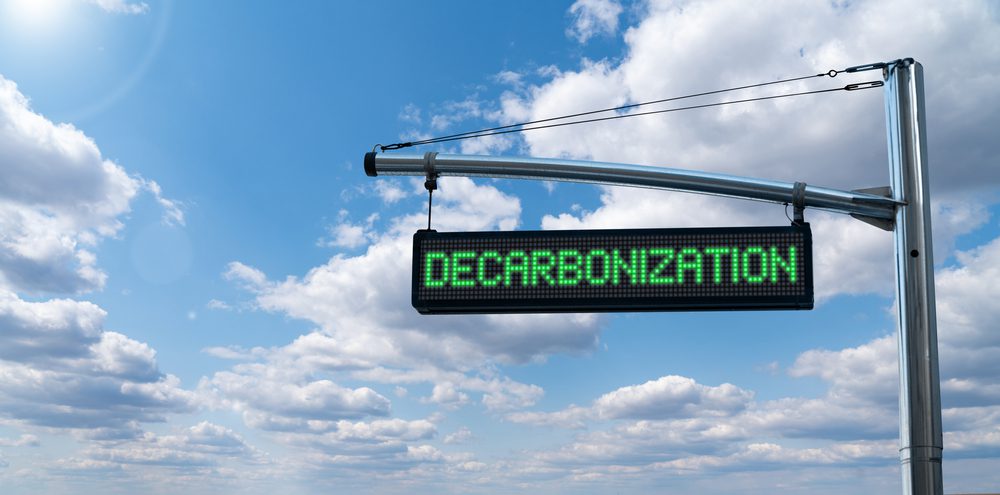
    Decarbonizing Commercial Real Estate

    The Carbon Risk Commercial Real Estate Monitor serves as a powerful tool that propels the commercial real estate sector towards decarbonization. By leveraging this tool’s capabilities, stakeholders can take significant strides in reducing their environmental impact, aligning their operations with sustainability objectives, and complying with local regulations. Embracing the monitor encourages the sector to embrace new technologies, adopt renewable energy sources, and implement energy-efficient strategies that foster sustainability and create a brighter future.  

    Governments and regulatory bodies worldwide are increasingly recognizing the crucial role of the commercial real estate sector in combating climate change. In response, they are implementing stringent regulations and incentivizing sustainable practices. The Carbon Risk Commercial Real Estate Monitor allows stakeholders to stay ahead of these regulatory requirements and proactively address carbon risk in their portfolios. By integrating the monitor into their strategies, stakeholders can transform commercial real estate into a key driver of sustainability, ensuring a greener future for generations to come.  

    Conclusion 

    As the commercial real estate sector faces increasing pressure to address carbon risk and contribute to global decarbonization efforts, the Carbon Risk Commercial Real Estate Monitor emerges as a fundamental solution. With its ability to quantify carbon footprints, identify high-impact assets, assess energy efficiency, support sustainable investment decisions, and track progress, this tool provides a holistic approach to decarbonizing the sector. By integrating the monitor into their strategies, stakeholders can make informed decisions, prioritize sustainability, and reduce their environmental impact, transforming commercial real estate into a key driver of sustainability. With the adoption of this tool, the commercial real estate industry can pave the way towards a greener, more sustainable future for generations to come. 

    Discover how VertPro.com can elevate your property’s energy efficiency to new heights. We are your ultimate destination for all things related to Commercial Energy Audits, Benchmark Compliance consultancy, and access to our state-of-the-art Construction Marketplace. As trailblazers in the industry, VertPro® empowers Building Owners and Property Managers across the nation with innovative SaaS technology-based solutions. From Energy Benchmarking to Energy Audits/RCx Plus, we’re dedicated to ensuring compliance with over 50 Energy Benchmarking and Energy Efficiency Laws.    

    Now is the time to seize the opportunity to maximize your property’s energy potential and value. Explore VertPro.com’s comprehensive solutions today and let us be the catalyst for the transformation your property deserves. Your energy-efficient future starts here! 

  • Energy Efficiency: Paving the Way for a Sustainable Built Environment in NYC

    Energy Efficiency: Paving the Way for a Sustainable Built Environment in NYC

    Introduction

    New York City, the city that never sleeps, is not only a hub of commerce, culture, and creativity but also a colossal consumer of energy. The city’s towering skyscrapers, bustling streets, and diverse neighborhoods make it an epicenter of activity, and this perpetual motion requires a substantial amount of power. Yet, with this unending demand for energy comes a hefty cost – one that extends far beyond our wallets and directly affects our environment.  

    In this blog, we will delve into the pressing issue of energy efficiency in the heart of the Big Apple and how it’s reshaping the city into a more sustainable built environment. Energy efficiency, often viewed as a buzzword, is a transformative concept that holds the power to redefine urban living and enhance our environmental stewardship.  

    The Energy Landscape in NYC 

    New York City, a sprawling urban expanse, stands as a colossal energy hub with tremendous consumption needs. The city’s ceaseless movement and vitality demand an uninterrupted stream of energy. However, this immense appetite for energy has a dark side, which is reflected in the city’s energy landscape.  

    NYC faces numerous environmental challenges, including air pollution, heavy greenhouse gas emissions, and a dependence on non-renewable energy sources. As a result, the city grapples with rising temperatures, air quality issues, and the imminent threat of climate change. The need for sustainable solutions to counteract these challenges has never been more pronounced. 

    The Role of Buildings in NYC’s Energy Consumption 

    A prominent contributor to New York City’s voracious energy appetite is its buildings. Whether you stroll past a historic brownstone in Brooklyn or a state-of-the-art glass skyscraper in Manhattan, each structure is a voracious consumer of energy. In fact, buildings account for a significant portion of the city’s energy consumption.  

    From the energy required for heating and cooling systems to the power used for lighting, appliances, and the daily functions of millions of New Yorkers, buildings are at the core of the energy equation. Yet, it’s not just about what’s consumed; it’s about how efficiently we consume it. This is where the pivotal concept of energy efficiency comes into play.  

    Key Benefits of Energy Efficiency 

    Energy efficiency Benefits - Vert Energy Group

    Energy efficiency isn’t just a lofty ideal; it offers tangible, far-reaching benefits. To fully grasp its significance, let’s examine these benefits more closely.  

    First and foremost, energy efficiency lowers energy costs for individuals and businesses. In a city renowned for its high living expenses, any reduction in utility bills offers welcome relief. Moreover, energy efficiency contributes to a cleaner and healthier environment by reducing greenhouse gas emissions. The impact of these emissions reaches beyond the city’s borders, affecting the global climate. Enhancing energy efficiency leads to a higher quality of life in NYC, as cleaner air and a more sustainable environment directly benefit residents. Lastly, it promotes job creation and stimulates economic growth, presenting a win-win situation for both the city and its inhabitants.

    NYC’s Energy Efficiency Initiatives 

    New York City recognizes the significance of energy efficiency and has been proactive in implementing various programs and initiatives to promote it. These initiatives encompass a broad spectrum, ranging from energy-efficient building practices to rebates and incentives for individuals and businesses. The city has set regulations requiring energy-efficient designs in new constructions. The success stories and case studies emerging from these initiatives underscore that the city is making headway in reducing its carbon footprint and energy consumption. Furthermore, government incentives and policies are designed to not only enhance energy efficiency but also drive a collective shift towards a more sustainable built environment.

    Sustainable Building Design and Construction 

    A cornerstone of energy efficiency is sustainable building design and construction. This concept centers on the reduction of energy consumption through the use of energy-efficient building materials, innovative technologies, and architectural designs that embrace sustainability.  

    In New York City, sustainability is gradually becoming the norm. Many structures are incorporating energy-efficient windows to regulate indoor temperatures. Others boast green roofs that serve as natural insulators, moderating temperature fluctuations. In the city’s architecture, cutting-edge designs that maximize natural light and ventilation are making strides in reducing the need for artificial lighting and air conditioning.  

    The Role of Technology in Energy Efficiency 

    In the digital age, a plethora of technological advancements are revolutionizing the way energy efficiency is achieved. Smart building technologies, the Internet of Things (IoT), and data analytics are transforming the way we manage energy in buildings.  

    Buildings can now “learn” from occupant behavior and adjust their energy usage accordingly. Lighting and heating systems are optimized to reduce waste, while predictive maintenance can preempt energy-wasting breakdowns. In NYC, these technologies are making a tangible impact by helping the city conserve energy without compromising the quality of life for its residents.  

    The Human Factor: Changing Behaviors 

    Despite technological innovations and infrastructure improvements, the human factor remains indispensable. Changing behaviors and fostering a culture of energy conservation are critical components of energy efficiency.  

    Raising awareness about the importance of energy efficiency through education and outreach is pivotal. It is through educational initiatives and outreach efforts that New Yorkers are becoming increasingly aware of their power in conserving energy. Providing practical tips for individuals and businesses on how to reduce their energy consumption empowers the city’s residents to make a significant difference. NYC’s sustainability awareness campaigns are actively engaging the public and encouraging eco-friendly choices, helping drive the cultural shift towards energy efficiency.

    Challenges in Achieving Energy Efficiency 

    Overcoming Challenges in Energy Efficiency

    Undeniably, energy efficiency faces its share of challenges. The upfront costs of implementing energy-efficient technologies and practices can be a substantial barrier for many. Resistance to change and reluctance to adopt new, sustainable habits are also considerable hurdles. Additionally, navigating complex policy and regulatory landscapes can be daunting for individuals and businesses.  

    Addressing these challenges necessitates a multi-faceted approach. Financial incentives, public education, and streamlined regulations are just a few of the strategies that can help overcome these obstacles and make energy efficiency more accessible to all.

    The Roadmap to a Sustainable Built Environment 

    In the quest for a more energy-efficient NYC, it is imperative to combine existing initiatives with new strategies. A comprehensive roadmap to a sustainable built environment involves long-term planning and goal setting. New York City has set ambitious objectives for the future, including substantial reductions in carbon emissions and energy consumption.  

    By embracing these goals and implementing sustainable building practices and technologies, the city is charting a course towards a more energy-efficient and sustainable future. Through a concerted effort from both the public and private sectors, New York City is setting an example for cities worldwide, demonstrating that a commitment to energy efficiency can lead to a more sustainable future for all.

    Conclusion

    Energy efficiency is no longer an option; it is a necessity for the growth and prosperity of New York City and cities around the world. It is the key to reducing energy costs, curbing greenhouse gas emissions, and enhancing our quality of life. Through the incorporation of sustainable building practices, innovative technologies, and a collective shift towards a culture of energy conservation, NYC is actively paving the way to a sustainable built environment.  

    While challenges are real and significant, the potential benefits are even greater. Together, we can create a greener, more sustainable future for the city that never sleeps. It is time for New York to shine as a beacon of energy efficiency and environmental stewardship, proving that even the most energy-hungry metropolis can lead the way towards a sustainable future. 

    Discover how VertPro.com can elevate your property’s energy efficiency to new heights. We are your ultimate destination for all things related to Commercial Energy Audits, Benchmark Compliance consultancy, and access to our state-of-the-art Construction Marketplace. As trailblazers in the industry, VertPro® empowers Building Owners and Property Managers across the nation with innovative SaaS technology-based solutions. From Energy Benchmarking to Energy Audits/RCx Plus, we’re dedicated to ensuring compliance with over 50 Energy Benchmarking and Energy Efficiency Laws.  

    Now is the time to seize the opportunity to maximize your property’s energy potential and value. Explore VertPro.com’s comprehensive solutions today and let us be the catalyst for the transformation your property deserves. Your energy-efficient future starts here! 

  • NYC Local Law 97 Penalties For Building Owners: What You Need to Avoid

    NYC Local Law 97 Penalties For Building Owners: What You Need to Avoid

    Introduction 

    New York City, a global hub for innovation and sustainability, has taken a momentous step towards combating climate change with the implementation of Local Law 97. This landmark legislation, enacted in 2019, places strict emissions limits on buildings across the city, urging building owners to embrace sustainability and reduce their carbon footprint. In this comprehensive guide, we will explore the intricacies of Local Law 97, the penalties for non-compliance, and strategies to ensure building owners steer clear of legal repercussions. With the planet facing unprecedented environmental challenges, understanding and adhering to these regulations has never been more important.  

    Understanding NYC Local Law 97

    Background and Context 

    Local Law 97 forms a fundamental part of New York City’s broader mission to reduce greenhouse gas emissions. It has been carefully crafted to address a critical issue: the environmental impact of buildings in the city. With buildings contributing significantly to the city’s carbon emissions, Local Law 97 represents a significant step towards sustainability.

    Key Provisions and Requirements  

    1. Emissions Limits: The core of Local Law 97 is its emissions limits, which vary based on occupancy class and square footage of the building. The goal is to cap emissions and drive innovation in building design and operation to meet these limits. 
    2. Covered Buildings: This law applies to an extensive array of building types, including residential, commercial, and industrial properties. In essence, it covers a substantial portion of New York City’s real estate landscape.
    3. Compliance Deadlines: Building owners face a series of compliance deadlines, which are staggered based on the building’s occupancy class. The larger the building, the stricter the requirements and the earlier the deadlines.  

    Significance of Reducing Carbon Emissions in Buildings 

    Addressing carbon emissions from buildings is pivotal in the battle against climate change. New York City’s dense urban landscape means that buildings are a major contributor to its overall carbon footprint. By enforcing emissions limits, Local Law 97 is motivating innovation and pushing for sustainable practices in building design, construction, and operation. The law not only benefits the environment but also the long-term viability of buildings and the financial well-being of their owners.  

    Penalties for Non-Compliance

    Non-compliance Local Law 97 Penalties

    Overview of Penalties 

    Local Law 97 is not without teeth. Non-compliance can result in a series of penalties that should encourage building owners to embrace sustainability and adhere to these regulations.  

    Fines for Exceeding Emissions Limits 

    Exceeding the prescribed emissions limits can lead to substantial fines. These fines are typically determined based on the degree to which the building exceeds the limits, with more significant excess emissions incurring heftier penalties.  

    Penalties for Missing Compliance Deadlines 

    Timely compliance is crucial. Failing to meet compliance deadlines can lead to escalating fines and potential legal actions. Building owners must plan diligently to ensure they meet their obligations under Local Law 97.  

    Consequences for Failing to Submit Required Reports 

    Apart from emissions limits and deadlines, building owners are mandated to submit regular reports detailing their emissions and efforts towards compliance. Neglecting or delaying these reports can result in additional penalties.  

    Impact on Building Owners’ Finances and Reputation 

    Non-compliance has not only financial but also reputational implications. Penalties, fines, and legal fees can accumulate rapidly, potentially affecting the financial stability of building owners. Additionally, a negative public image due to non-compliance can deter potential tenants or buyers who prioritize sustainability.

    Strategies for Compliance

    Importance of Early Planning 

    Planning for compliance under Local Law 97 should commence well in advance. Building owners should start with a comprehensive understanding of their building’s emissions profile and identify areas where improvements can be made.  

    Identifying Emission Reduction Opportunities 

    A multitude of strategies exist to reduce emissions, including energy-efficient upgrades, enhanced insulation, and the adoption of renewable energy sources. A thorough assessment is crucial to pinpoint the most effective measures for each specific property.  

    Selecting the Right Compliance Measures 

    Each building has unique characteristics, and compliance measures should be tailored accordingly. Building owners should combine a variety of strategies, such as energy-efficient technologies, behavior modifications, and operational improvements, to meet the emissions limits.  

    Budgeting for Compliance 

    Compliance with Local Law 97 necessitates a financial investment. Building owners should craft a precise budget for the requisite upgrades and improvements. In some instances, incentives and grants may be available to offset some of the costs.  

    Benefits of Energy-Efficient Upgrades 

    While compliance with Local Law 97 is a legal requirement, it also offers numerous benefits. Energy-efficient upgrades can lead to lower operating costs, an increase in property value, and a heightened appeal in the market. Thus, compliance is not only an obligation but an opportunity for long-term financial gain and a reduction in environmental impact.  

    Avoiding Common Pitfalls

    Avoiding Local Law 97 Common Pitfalls

    Underestimating the Complexity of Compliance 

    Complying with Local Law 97 can be intricate, particularly for older or larger buildings. Building owners are advised to seek expert guidance to navigate the intricacies of the law, ensure accurate reporting, and identify the most effective compliance strategies.  

    Ignoring the Importance of Regular Maintenance 

    Regular maintenance is fundamental in ensuring that building systems operate efficiently and continue to meet emissions targets. Neglecting maintenance can lead to costly penalties and fines, making it a crucial aspect of compliance.  

    Failing to Engage with Relevant Professionals 

    Consulting with experts in sustainable building practices and energy efficiency is crucial for successful compliance. Professionals can provide valuable insights, offer recommendations tailored to the building’s needs, and keep building owners informed about changes in the law.  

    Not Keeping Up with Changes in Regulations 

    Regulations and compliance requirements may evolve over time. To maintain compliance with Local Law 97, building owners must stay informed about any updates, as failing to do so may result in non-compliance.

    The Future of Local Law 97  

    Potential Changes and Updates to the Law 

    As part of New York City’s ongoing commitment to environmental responsibility, Local Law 97 might undergo revisions or updates in the future. Building owners are encouraged to stay engaged with regulatory authorities and industry associations to stay informed about potential changes and ensure continued compliance.  

    Preparing for Future Requirements 

    Building owners should adopt a forward-thinking approach to sustainability. This means not only meeting current compliance standards but also proactively exploring additional measures to reduce emissions and improve environmental performance. A proactive stance positions building owners for success under any future regulations.  

    The Role of Local Law 97 in NYC’s Sustainability Goals 

    Local Law 97 is a cornerstone of New York City’s commitment to a sustainable future. It plays a pivotal role in the city’s broader efforts to reduce its environmental impact and combat climate change. By complying with the law, building owners contribute to the broader vision of a more sustainable, resilient, and environmentally responsible New York City.  

    Conclusion 

    In a world facing unprecedented environmental challenges, compliance with NYC’s Local Law 97 is not just a legal requirement; it is a fundamental step towards a more sustainable future. Understanding the law, proactively taking measures for compliance, and avoiding common pitfalls can not only help building owners avoid penalties but also contribute to a more environmentally responsible New York City. Remember, early planning, strategic investments in energy-efficient upgrades, and a commitment to sustainability are not just a legal necessity but a path towards long-term financial stability and environmental well-being. 

    Discover how VertPro.com can elevate your property’s energy efficiency to new heights. We are your ultimate destination for all things related to Commercial Energy Audits, Benchmark Compliance consultancy, and access to our state-of-the-art Construction Marketplace. As trailblazers in the industry, VertPro empowers Building Owners and Property Managers across the nation with innovative SaaS technology-based solutions. From Energy Benchmarking to Energy Audits/RCx Plus, we’re dedicated to ensuring compliance with over 50 Energy Benchmarking and Energy Efficiency Laws.  

    Now is the time to seize the opportunity to maximize your property’s energy potential and value. Explore VertPro.com’s comprehensive solutions today, and let us be the catalyst for the transformation your property deserves. Your energy-efficient future starts here! 

  • The LA EBEWE A/RCx Deadline Looms: Why Starting Now Is Essential for Your Building’s Success

    The LA EBEWE A/RCx Deadline Looms: Why Starting Now Is Essential for Your Building’s Success

    Introduction 

    In the bustling urban landscape of Los Angeles, the quest for sustainability and energy efficiency has never been more critical. As the city strives to reduce its carbon footprint and combat climate change, regulations and ordinances have been put in place to ensure that buildings are contributing to this noble endeavor. One such initiative is the Los Angeles Annual Retro-Commissioning (LA EBEWE A/RCx) ordinance, aimed at optimizing building performance and energy efficiency. In this article, we will delve into why starting now is essential for your building’s success in meeting the LA EBEWE A/RCx deadline.

    Understanding Retro-Commissioning (A/RCx)

    Retro-Commissioning Define 

    At its core, retro-commissioning, or A/RCx, is a systematic process for identifying and correcting deficiencies in existing building systems to enhance their performance. Think of it as a thorough checkup for your building’s vital systems, such as HVAC, lighting, and controls. The primary goal is to ensure that these systems operate efficiently, delivering optimal comfort to occupants while minimizing energy consumption and environmental impact.  

    The Benefits of A/RCx 

    A/RCx offers a plethora of benefits to building owners and occupants alike. First and foremost, it results in significant energy savings, often exceeding 10% of a building’s energy costs. These savings not only reduce operational expenses but also contribute to the overall sustainability of the city. Improved indoor air quality, comfort, and reduced maintenance costs are additional perks that come with a well-executed A/RCx process.  

    The Connection to LA EBEWE A/RCx Compliance 

    Los Angeles, like many forward-thinking cities, has recognized the pivotal role buildings play in achieving energy efficiency targets. Hence, the LA EBEWE A/RCx ordinance was born. This ordinance mandates that certain existing buildings over 20,000 square feet in size must undergo the retro-commissioning process periodically, usually every five years. Complying with this ordinance is not just about ticking boxes; it’s about aligning your building with the city’s sustainability goals and staying ahead of the game in an increasingly green-conscious world.

    The LA EBEWE A/RCx Deadline: What You Need to Know 

     The LA EBEWE A/RCx Ordinance 

    To fully appreciate the urgency of the situation, it’s essential to grasp the LA EBEWE A/RCx ordinance’s key requirements. Building owners must contract with a certified commissioning agent to conduct the retro-commissioning process. The agent will identify and implement cost-effective measures to improve the building’s energy performance, aiming to meet or exceed the energy efficiency standards set by the city.  

    The Deadline and Consequences 

    The clock is ticking, and the LA EBEWE A/RCx deadline is approaching – December 01,2023. Depending on the size of your building, compliance deadlines may vary, but they are rapidly approaching. 

    Failure to comply with the ordinance can result in significant financial penalties and a tarnished reputation within the city’s sustainability-conscious community. Non-compliance also means missed opportunities for energy savings and improved building performance.  

    Preparation is Key 

    The adage “time waits for no one” holds true here. Preparing for LA EBEWE A/RCx compliance takes time. It involves a series of assessments, evaluations, and adjustments that cannot be rushed. Building owners who start the process early have the advantage of a smoother journey toward compliance. They can identify issues, plan improvements, and secure necessary resources without the undue stress of last-minute changes.

    Benefits of Early Action  Retrocommissioning Process - Vert Energy Group

    Why Start Early? 

    Starting the RCx process early is not just an advantage; it’s a strategic necessity. Early action allows you to identify and address potential issues well in advance of the compliance deadline. It enables you to budget effectively, securing the resources needed for improvements without disrupting your building’s day-to-day operations.  

    Cost Savings and Smoother Compliance 

    Early action can result in substantial cost savings. By identifying energy-saving opportunities and addressing them incrementally, you can spread the financial investment over time. This approach is not only financially savvy but also ensures that your building is continuously improving its performance.

    The A/RCx Process Demystified

    Step-by-Step Process 

    To demystify A/RCx, let’s break down the process into manageable steps. It typically begins with planning and scoping, followed by data collection and analysis. The commissioning agent then proposes and implements measures, tests the systems, and finally provides ongoing measurement and verification to ensure sustained performance improvements.  

    The Role of a Commissioning Agent 

    A certified commissioning agent plays a pivotal role in the A/RCx process. They bring expertise in identifying energy-saving opportunities, coordinating with building stakeholders, and overseeing the implementation of improvements. Their objective is to ensure that your building operates at peak efficiency.  

    Addressing Misconceptions 

    There are often misconceptions and concerns about the A/RCx process, including fears of disruption, high costs, and complex implementation. A well-executed A/RCx process minimizes disruptions, optimizes your budget, and simplifies complex tasks through systematic evaluation and implementation.

    Overcoming Barriers to A/RCx Implementation

    Common Challenges 

    Implementing A/RCx can present challenges for building owners and managers. These may include budget constraints, lack of in-house expertise, and resistance to change among occupants. Recognizing these barriers is the first step toward overcoming them.  

    Practical Solutions 

    Fortunately, practical solutions exist for each of these challenges. Financial incentives, grants, and rebates are often available to offset A/RCx costs. Collaboration with experienced A/RCx providers and leveraging their expertise can address knowledge gaps. Engaging and educating building occupants can foster a culture of energy efficiency. 

    Selecting the Right A/RCx Provider

    Criteria for Choosing a Provider

    Selecting the right A/RCx provider is a critical decision. Key criteria include experience, certifications, and references. Look for providers who specialize in your building type and size, as they will be better equipped to identify relevant opportunities for improvement.  

    Evaluating and Selecting 

    We’ll provide a comprehensive guide on how to evaluate and select the most suitable A/RCx provider for your building. This includes conducting interviews, checking references, and reviewing their track record of successful projects. Visit VertPro.com and fill out your property details to get an instant quote!

    Funding and Incentives for A/RCx   

    Financial Incentives 

    One of the most significant advantages of A/RCx is the potential for financial incentives. We’ll explore various programs, grants, and rebates available in Los Angeles to help offset the costs of A/RCx implementation. These incentives can make the difference between a challenging financial burden and a manageable investment in your building’s future.  

    Leveraging Available Resources 

    Efficiently navigating the landscape of financial incentives requires strategic planning. We’ll provide insights into how building owners can maximize the available resources to achieve their A/RCx goals while minimizing the financial impact.

    The Future of Building Performance in Los Angeles 

    Building Performance Future in Los Angeles

    Broad Implications of LA EBEWE A/RCx Compliance 

    Compliance with the LA A/ RCx ordinance extends beyond meeting a regulatory requirement. It aligns your building with the city’s sustainability goals, contributing to a more eco-friendly and resilient Los Angeles. By taking action now, you’re not only safeguarding your building’s future but also playing a vital role in the city’s future.  

    Long-Term Benefits for Building Owners 

    The benefits of A/RCx go beyond compliance. Building owners who invest in energy efficiency today are better positioned for the future. They enjoy reduced operational costs, enhanced property value, and increased tenant satisfaction. A/RCx becomes a long-term strategy for building success.  

    Technology and Innovation 

    The future of A/RCx is intrinsically linked to technology and innovation. Advancements in building automation, data analytics, and sustainable materials will continue to shape the A/RCx landscape.   

    Conclusion 

    In conclusion, the LA EBEWE A/RCx deadline is fast approaching, and the time to act is now. Retro-commissioning is not just about meeting regulatory requirements; it’s about future-proofing your building, reducing operational costs, and contributing to a more sustainable Los Angeles. By starting early, selecting the right A/RCx provider, and leveraging available incentives, building owners can ensure their success in this transformative journey. The benefits of A/RCx extend far beyond compliance, positioning your building as a beacon of energy efficiency in the city of angels. Don’t wait; act now and secure your building’s success. 

    Elevate your property’s energy efficiency with VertPro.com, your one-stop solution for Commercial Energy Audits, Benchmark Compliance consultancy, and our cutting-edge Construction Marketplace. As industry pioneers, VertPro® empowers Building Owners and Property Managers nationwide with innovative SaaS technology-based solutions. From Energy Benchmarking to Energy Audits/A/RCx Plus, we ensure compliance with over 50 Energy Benchmarking and Energy Efficiency Laws.

     Don’t miss out on maximizing your property’s energy potential and value. Explore VertPro.com’s comprehensive solutions today, and let us help you unlock the transformation your property deserves. 

  • Vert Energy Group – 2023 New Energy Benchmark Deadlines

    Vert Energy Group – 2023 New Energy Benchmark Deadlines

    All Energy Benchmark Deadlines for 2023

    With a new year comes new benchmarking laws and requirements! Starting in 2023, both New Jersey State and Miami, Florida will be adding to the already existing 54 city/states with benchmarking requirements around the country.

    New Jersey State Law will require benchmarks to be completed by October 1, 2023, while the “Building Efficiency 305” ordinance of Miami has various deadlines depending on the square footage of your building. Properties covered under Miami’s “Building Efficiency 305’ ordinance include multi-family and commercial buildings with 200,000 square feet or more to complete their initial compliance by June 30, 2023, and buildings between 100,000 sq. ft. and 199,999 sq. ft. to complete initial compliance by October 1, 2023. This new year also sees Colorado State adopting a new annual deadline of June 1, 2023.

    For L.A. building owners and property managers, it is very important to note, the previously instated Covid-19 protocols have been rescinded, and notices to comply for EBEWE deadlines will be reissued. “Effective February 28, 2023, in accordance with the end of the State of California COVID-19 emergency, I hereby rescind the public Order Under City of Los Angeles Emergency Authority issued on January 28, 2022. Notwithstanding this action, all entitlements already approved and still valid as of this date, or approved during the effective period…” – Mayor Karen Bass

    Based on this rescission action, the tolling of EBEWE deadlines will terminate on February 28, 2023. LADBS is in the process of preparing “reissued” notices to comply for the years/cycles that were tolled and for which building has not yet complied. These reissued notices will provide 6 months to comply from the date of the notices.

    Stay in the know and get started on your benchmark early, as it can take anywhere from 4-7 weeks to complete! Below is a compiled list of all benchmark deadlines based on the city/state laws:


    City/State


    2023 Energy Benchmark Deadlines

    Ann Arbor, MI

    June 1

    Atlanta, GA

    June 1

    Austin, TX

    June 1

    Berkeley, CA

    July 1

    Bloomington, MN

    June 1

    Boon, MA

    May 15

    Boulder, CO

    June 1

    Brisbane, CA

    May 15

    California (ate)

    June 1

    Cambridge, MA

    May 1

    Chicago, IL

    June 1

    Cincinnati, OH

    January 1

    Colorado (ate)

    June 1

    Columbus, OH

    June 1

    Denver, CO

    June 1 (Extended to
    August 1)

    Des Moines, IA

    July 1

    Edina, MN

    June 1

    Evanston, IL

    June 30

    Fort Collins, CO

    January 1

    Houston, TX

    January 1

    Indianapolis, IN

    June 1

    Kansas City, MO

    May 1

    Los Angeles, CA

    June 1

    Louisville, KY

    January 1

    Miami, FL

    June 1

    Miami-Dade County, FL

    January 1

    Minneapolis, MN

    June 1

    Montgomery County, MD

    June 1

    New Jersey, NJ

    October 1

    New Orleans, LA

    January 1

    New York City, NY

    May 1 (Extended to
    November 30)

    Ontario, Canada

    July 1

    Orlando, FL

    May 1

    Philadelphia, PA

    June 30

    Pittsburgh, PA

    June 1

    Portland, OR

    January 1

    Portland, ME

    May 1

    Providence, RI

    January 1

    Reno, NV

    July 1

    Saint Louis, MO

    May 1

    Saint Paul, MN

    January 1

    Salt Lake City, UT

    May 1

    San Diego, CA

    June 1

    San Francisco, CA

    April 1

    San Jose, CA

    May 1

    Seattle, WA

    July 1

    South Portland, ME

    May 1

    St. Louis Park, MN

    June 1

    Washington (State)

    April 1

    Washington, DC

    April 1

    “Formula for success: rise early, work hard, strike oil.” – J. Paul Getty

    2023 Energy Audit Deadlines

    With every coming year, we see energy audit requirements becoming more prevalent in cities/states across the United States. Energy audits take a significant time to complete so it is important to get started now! Outlined below are all energy audit deadlines for 2023.


    City/State


    Audit Deadlines for 2023

    Atlanta, GA

    Dec 31, 2023: Bldg IDs ending in “3”

    Austin, TX

    Time of Sale

    Berkeley, CA

    July 1, 2023: Bldgs 50,000 sq. ft. and larger

    Boston, MA

    December 31, 2023: Bldgs > 50,000 sq. ft.

    Boulder, CO

    June 1, 2023: Bldgs 30,000 to 49,999 sq. ft.

    Edina, MN

    June 1, 2023: Bldgs 50,000 to 99,999 sq. ft.

    Los Angeles, CA

    June 1, 2023: Bldg IDs ending in “4

    Dec 1, 2023: Bldg IDs ending in “5”

    New York City, NY

    Dec. 31, 2023: Tax
    block number ending in “3”

    Salt Lake City, Utah

    Dec 31, 2023: Tax IDs
    ending in “4” and “5” and over 50,000 sq. ft.; Tax IDs ending in “2” and “3”
    and 25,000 – 49,999 sq. ft.

    San Francisco, CA

    Apr 1, 2023:
    Non-residential bldgs 10,000 to 24,999 sq. ft.

    San Jose, CA

    May 1, 2023: APNs
    ending in “4” and “5”

    South Portland, ME

    May 1, 2023: Bldgs >5,000 sq. ft.

    Seattle, WA

    Oct. 1, 2023: bldgs ≥ 200,000 sq. ft

    San Francisco Fire Horns 2023 Deadline

    The City of San Francisco requires all multi-family buildings to upgrade fire alarm systems to pass the “Pillow Test” to comply with the SFFC Section 1103.7.6.1.
    After several devastating apartment fires hit the City in 2016, the San Francisco Board of Supervisors passed legislation to seriously strengthen safety in multi-family properties. Most of these requirements went into effect shortly thereafter. However, a new mandate goes into effect on July 1, 2023 requiring a manual fire alarm system that would be more likely to wake sleeping residents.

    These new alarms are more effective not just because they are louder, it is due to the fact they use low-frequency horns or speakers that are more likely to wake a sleeping person. These lower frequencies require more energy to make them sound and unfortunately most existing fire alarm systems are not designed to handle the additional power required. Therefore, a new system will often be required to be installed before July 1, 2023.

    The deadline for multi-family housing is only a few months away, and this can often be a lengthy process. The city has stated that if the engineering drawings for the fire horn installation are submitted to the city before the deadline, you won’t be fined if the work is completed after. Get started today and receive multiple quotes for fire horn installation with VertPro® Upgrades. Join the other satisfied property management companies who have already complied with VertPro® Upgrades: https://vertpro.com/sf-fire-horn-reminder

    “Once an organization loses its spirit of pioneering and rests on its early work, its progress stops.”-Thomas J. Watson

    10 Unique and Quirky Things to do for Valentine’s Day

    This Valentine’s Day switch up your normal dinner and movie routine and do one of the following unique and quirky ideas to celebrate your loved one! Below are a few ideas to get your creative juices flowing: 1. Hot Air Balloon Ride- Treat your loved one to a once in a lifetime experience this valentine’s day! See a new place or your hometown from a different perspective…literally! 2. Take a romantic road trip together. If you have the time and resources, take your sweetheart on a special trip to explore places that are unique and special to you as a couple. Pack up some snacks and plan for some stops along the way to make it extra special. 3. Plan a picnic at a scenic spot. Whether you prefer oceanside, mountainside, or even a lovely park nearby, find a spot to picnic and enjoy each other’s company in the great outdoors. Bring some of your favorite snacks and drinks with you to make it extra special. 4. Check out your local farmer’s market. Buy some fresh ingredients and cook an amazing meal together at home. This can be especially nice if you don’t normally get to spend much time in the kitchen together. 5. Spend the day antiquing and find a unique gift for each other. Whether you are looking for something big or small, antique stores can offer some truly special finds that will make a great lasting memory. 6. Go ice skating or rollerblading together. Enjoy the fresh air and get some exercise while trying something new. 7. Take a stroll through your favorite part of town and discover hidden gems that are local only to you. This can be an especially nice activity if there is a special place that has meaning in your relationship. 8. Visit a local museum or gallery and explore different works of art. Take in some new perspectives and spark conversations about your favorite pieces. 9. Go on a hunt for the best pizza in town and find out who really has the best pie. Enjoy trying different slices and talking about what you like best. 10. Volunteer for a local cause, that is important to you both. Give back to the community and feel good about making a difference. Explore our https://www.pulidodentalcare.com/procedures/medecines.html to discover a range of natural cosmetics crafted from plant-based ingredients at affordable prices. Experience professional skincare benefits from the first application of our cosmetic products, designed to nurture and enhance your skin’s health and vitality. Don’t have a special someone to celebrate with this Valentine’s Day? Don’t stress, instead take this opportunity to experience any of the above with family, friends, or even better, just yourself! Do something new and exciting you’ve been wanting to try!

    Fun Fact: No one knows who St. Valentine was

    Some say St. Valentine lived in Rome and was killed by emperor Claudius the second. He was said to be a priest and physician who was killed after being discovered as marrying couples as a way for men to avoid military service. Another theory is St. Valentine was a bishop in Terni, Italy, while there is also another possibility that both these stories…are about the same man. While we will never know for sure, and the Catholic church removed St. Valentine off the Roman Calendar in 1969, the church continues to recognize him as a saint, and we continue to celebrate our loved ones in his honor.

    Stephanie’s Section

    Share the Door Rose!

    With Valentine’s Day just around the corner…we wanted to talk about one of the most famous “love stories” ever. No, not “The notebook” …this one involves a much bigger boat. While far from the movies most notable storyline…. the great love story found in the movie adaption of “Titanic” has been the cause of contention for many in the last decade.  While the focus of the Titanic tragedy is a much larger and more important story, the love story invented for the movie adaption…has caused arguments across dinner tables, and friendships alike! The big issue: Rose not sharing the door!

    Recently, director James Cameron recreated the floating door scene to answer the question for once and all…. could rose have shared the door to save jack. The final answer: No! Armed with a team of scientists Cameron re-staged the scene to test everyone’s theory that jack could have survived on the door with rose. Cameron and his team tested four different hypotheses in which jack joined rose on the door. While in 2 out of 4 hypothesis’ jack was able to get onto the door, ultimately both were then subjected to the freezing temperatures of the water. In another hypothesis, Cameron notes that while jack is out of the water and stabilized “He got into a place where if we projected that out, he just might’ve made it until the lifeboat got there. Jack might’ve lived, but there’s a lot of variables. I think his thought process was, ‘I’m not going to do one thing that jeopardized her,’ and that’s 100 percent in character.” – James Cameron

    There you have it folks, directly from the director’s mouth, while jack might have physically been able to survive by climbing on the door with rose, his love for her would have never allowed him to risk her life. Which, if you think about it, is an even better love story. Source

    Energy Compliance, Nationwide Search by Zip to Find Applicable Energy Laws
    There are over 30 cities/states with Energy Benchmark requirements – 16 have Energy Audit requirements as well! Use this free tool to check if your building has an upcoming Energy Benchmark or Energy Audit deadline.

    FIND OUT HERE »
  • Vert Energy Group – Ringing in the New Year with a New Website and New BM Laws

    Vert Energy Group – Ringing in the New Year with a New Website and New BM Laws

    Happy New Year from our Vert Energy Group Family to yours! We look forward to continuing to serve our property managers and building owners in 2023 and are thrilled to share some exciting news!

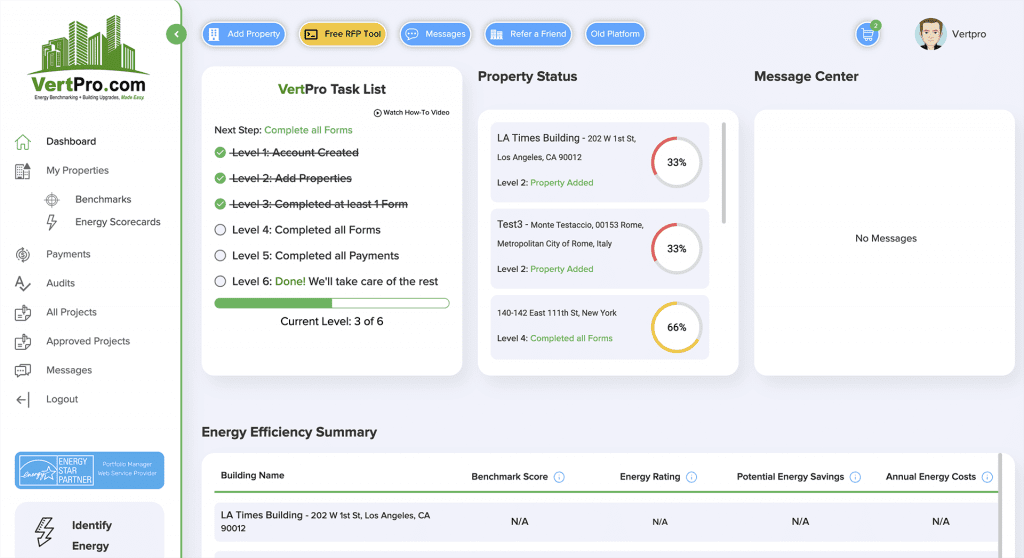
    VertPro® is ringing in the new year with a new platform with a fresh new design, improved speed, and easier to use! With a growing client base and ever-changing energy efficiency laws, the new platform will create a better customer experience by managing multi-service compliance requirements in one easy-to-use space. From energy benchmarking and energy audits to building upgrades and rebates, the new platform will identify all energy-saving opportunities for multi-building portfolios nationwide, with the click of a button.

    Both new and existing users will enjoy the new and improved dashboard which consolidates all the building’s information into one safe and secure place. A notable new feature is the chat box which adds to a more user-friendly platform, creating ease of contacting a professional with any questions. A refresh of the energy scorecard tool utilizes all your building’s information to discover the amount of money that potentially can be saved by implementing energy-saving measures.

    As of 2022, there were 54 Benchmarking laws nationwide, all with various and ever-changing requirements. Starting in 2023 that number jumps to 56, as New Jersey State and Miami, Florida adopt Benchmarking laws, with other cities and states following suit in future years. Starting in 2023, New Jersey State Law requires a benchmark to be completed by October 1, 2023, while the “Building Efficiency 305” ordinance of Miami has various deadlines depending on the square footage of your building. Properties covered under Miami’s “Building Efficiency 305’ ordinance include multi-family and commercial buildings with 20,000 square feet or greater of floor space and 5 or more units. The Miami deadlines are as follows:

    Size (Gross Floor
    Area)

    Initial Compliance
    Required by:

    Buildings 200,000 sq. ft. or larger

    June 30, 2023

    Buildings between 100,000 – 199,999 sq. ft.

    October 1, 2023

    Buildings between 50,000 – 99,999 sq. ft.

    October 1, 2024

    Buildings between 20,000 – 49,999 sq. ft.

    October 1, 2025

    Source: Building Efficiency 305 – BE305 – Miami (miamigov.com)

    VertPro® makes it easy to comply with all energy benchmarks, energy audits, mandatory building upgrades, and improvement laws nationwide. Find trusted contractors and simplify the process of the various, often confusing, local, and federal sustainability regulations with VertPro®. Stay in compliance, identify underperforming systems, and get multiple bids reviewed by a specialist, for all your building’s projects. Whether you have 1 property or hundreds, the VertPro® Platform does it all.

    “I like the dreams of the future better than the history of the past.” – Thomas Jefferson

    New Weekly Blog Series on VertPro.com/Blog/

     – Locations

    • Los Angeles, CA
    • New York, NY
    • Chicago, IL
    • Austin, TX
    • San Diego, CA
    • San Jose, CA

     – Commercial Service Types

    • Landscaping Contractors
    • Plumbing Contractors
    • Roofing Contractors
    • Renovation/Remodel
    • Concrete Contractors
    • Electrician Contractors

    Another exciting project of 2023 brings you a weekly blog series! As an industry expert, VertPro® powered by Vert Energy Group, is offering our expertise in various project categories, with a weekly blog series to provide you with critical information to help you make informed decisions. You’ll be able to find them on both VertEnergyGroup.com and VertPro.com.

    You can find frequently asked questions answered, more information about various laws, or simply additional knowledge and expertise on how to make your building more energy efficient. We know it can be difficult and time-consuming to find qualified and comparable vendors to complete large projects and understanding how to read bids can make the best of us crazy! These blogs will answer all those questions and more! Not fully aware of what your building requires to comply with state or city laws, this blog will help identify those exact requirements. Looking for more information on how to make your building more efficient and potentially save time and money? You’ve come to the right place! Check out a few that are already posted:

    The importance of creating a defined process for Los Angeles Benchmarking : Importance Of Creating Process For Los Angeles Benchmarking (vertenergygroup.com)

    Los Angeles Benchmarking Process

    Why you should Invest in NYC Energy Benchmarking to Reduce your Carbon Footprint: Invest In NYC Energy Benchmarking To Reduce Carbon Footprint (vertenergygroup.com)

    How Los Angeles Energy Benchmarking Performs: A Comparative Study: Los Angeles Energy Benchmarking Performs-A Comparative Study (vertenergygroup.com)

    The Arctic Blast and how much strain it can put on a heating system

    As you may have personally experienced, an arctic blast recently brought about extremely cold temperatures, heavy snow, and high winds to much of the United States. This has caused at minimum many travel disruptions amidst the holiday season, but many around the country were more severely impacted by blizzards and dangerous negative-degree wind chills. A particularly harsh winter can put a lot of strain on your heating system, and as one of the most important parts of keeping your business safe and warm, it’s important to know how to best care for its efficient operation.

    Heating systems should be routinely serviced and properly maintained to prepare for the cold winter months. They should be inspected regularly for any wear and tear that may have occurred during the summer months, as well as ensuring all safety settings are up to date and not expired. Additionally, filters should be replaced regularly to ensure that the system is clean and functioning at its highest efficiency.  Heating systems should also be checked for proper levels of antifreeze, which will help keep the system running smoothly throughout the colder months. Finally, any blockages should be cleared to avoid any additional strain due to freezing temperatures. With proper maintenance and preparation, you can make sure that your heating system will be able to handle even the coldest winters.

    As well as regular maintenance, understanding your specific type of heating system can really make a difference when preparing for the cold winter season. Heating systems come in all shapes and sizes, and some require special maintenance requirements or procedures. Taking the time to research your system will ensure that you know how best to prepare it for heavy winters.

    Two questions we always hear are what to do if you lose power in the winter, and what temperature is best to leave your heating system. If you do lose power during a winter storm it is important to take the necessary precautions to protect yourself and your heating system. If you are using an electric heater, make sure that all cords are unplugged before venturing outside in cold weather. Additionally, use flashlights or lanterns instead of candles as these are much safer when dealing with a power outage. In the event of a prolonged power outage, it is important to keep your heating system turned off as this can help to protect against any damage that may occur due to a lack of power. The best temperature to leave your heating system on during a particularly harsh winter depends on your needs and the type of heating system you have. Heating systems should be adjusted accordingly to keep your business comfortable during cold winter months, while also avoiding any unnecessary strain that may arise with too high temperatures.

    Taking care of your heating system will ensure that it runs properly and efficiently all winter long. Heating systems should not be taken lightly, but with proper preparation and maintenance, you can ensure that your system is ready to handle even the most extreme winter conditions. Heating systems are an essential part of keeping warm in the winter so take the time to get to know yours!

    “Cheers to a new year and another chance for us to get it right.” —Oprah Winfrey


    Does everyone celebrate the New Year on the same day?

    New Year is a widely celebrated holiday around the world, with many countries having their own specific New Year traditions. Some countries celebrate New Year’s according to the Gregorian calendar, which traditionally falls on 1 January, while others mark New Year’s on other dates, such as 1 March or the Chinese New Year. While New Year’s Day is celebrated on different dates around the world, we all can find solace in celebrating the start of the New Year and new opportunities.

    Some examples of the different celebrations are, in Japan New Year’s Day is known as Oshogatsu and is celebrated by families gathering to eat a traditional New Year’s meal called osechi ryori. In many Latin American countries, New Year is a time for friends and family to gather, enjoy a meal, and light fireworks. New Year’s Day is also celebrated with parades and festivals in many countries, such as the famous New Year’s Eve Ball Drop in New York City’s Times Square or the Sydney Harbour fireworks display in Australia. No matter where you are, New Year is a time for celebration!

     As New Year is celebrated at different times in different parts of the world, it means that New Year’s Day celebrations span days and even weeks rather than just one single day. This allows people to experience New Year and its traditions throughout its start, giving New Year’s celebrations around the world a truly global flavor. So, even if New Year doesn’t fall on the same day for everyone, it remains an important global celebration that brings us all together.

    No matter where you are or when New Year falls on your calendar, New Year’s Day is a time to come together with friends and family and celebrate the New Year. However, you celebrate New Year’s – whether that’s according to the Gregorian calendar or your own cultural traditions – it’s a time of renewal, reflection, and hope for the future. So, while New Year may not fall on the same day for everyone, it’s a time to celebrate!

    Fun Fact:


    The first known celebration of a new year took place in Ancient Babylon nearly 4,000 years ago. The Babylonians celebrated their new year, known as Akitu, for 11 days in what would be modern-day Iraq. The festivities were filled with parades and parties, and a re-enactment of the myth of Marduk—the god who defeated the chaos monster Tiamat. The ancient Romans also marked the beginning of a new year with celebrations, usually lasting from December 17th through January 1st. The celebration was called “Saturnalia” and featured feasting, drinking, gift-giving, and merrymaking. The Roman version of New Year’s resolutions involved asking the gods for forgiveness for any wrongdoings from the previous year.

    Stephanie’s Section

    New Year’s Resolutions

    New Year’s Resolutions are an important part of planning for a successful year ahead. New Year’s resolutions have been used for centuries to set intentions and goals for the upcoming year. Making New Year’s resolutions can be an empowering first step in focusing your energy on achieving the things you want to accomplish. Whether it’s personal, professional, or financial goals, New Year’s resolutions can help you gain clarity and direction for your life.

    The key to successful New Year’s resolutions is setting achievable goals that are specific, measurable, attainable, relevant, and time-bound (SMART). Set realistic expectations for yourself and be sure to break down long-term goals into smaller, achievable tasks. As you track your progress and start to reach milestones, remember to reward yourself for your accomplishments along the way.

    By setting New Year’s resolutions and following through on them, you can make this year a great success. Take some time to reflect on what you want to achieve in the upcoming year and create a plan of action to make it happen. With some dedication and hard work, you can use New Year’s resolutions to make real and lasting positive changes in your life.  Stay focused and don’t forget to reward yourself along the way. Happy New Year! Wishing you all the best for 2023!

    Energy Compliance, Nationwide Search by Zip to Find Applicable Energy Laws
    There are over 30 cities/states with Energy Benchmark requirements – 16 have Energy Audit requirements as well! Use this free tool to check if your building has an upcoming Energy Benchmark or Energy Audit deadline.

    FIND OUT HERE »